

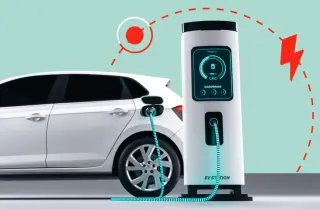
Electric vehicles (EVs) are becoming increasingly common in UK business fleets, but charging a company car at home creates a practical question for employers: how should employees be reimbursed for the electricity they use?
Charging a company car at home is often cheaper and more convenient than using public charging stations, but businesses need a clear process for calculating and paying back the cost of business charging.
This guide explains how claiming for charging a company car at home works, what HMRC says about reimbursement, the current Advisory Electricity Rates (AER), and the different ways businesses can manage home EV charging costs.
Last updated: September 2026.
Charging a company car at home: why reimbursement matters
For employees with an electric company car, home charging can be the most convenient way to keep the vehicle topped up. However, the electricity used for business journeys is a cost that needs to be accounted for by the employer.
Without a clear reimbursement process, businesses risk:
Overpaying or underpaying employees
Creating confusion around expense claims
Making it harder for employees to understand what they can claim
Creating unnecessary administration for fleet and finance teams
Making employees reluctant to use an EV for business travel
A clear home EV charging reimbursement policy gives both the business and employee confidence that charging costs are being calculated and paid fairly.
For more information about EV charging and the options available to businesses, see our business EV charging solutions.
What HMRC says about charging a company car at home
HMRC provides Advisory Electricity Rates (AERs) that employers can use when reimbursing employees for business mileage in fully electric company cars.
The current rates, from 1 September 2026, are:
Charging location | Advisory Electric Rate |
|---|---|
Home charging | 7p per mile |
Public charging | 15p per mile |
The rates apply to employees using fully electric company cars and are designed to provide a simple way for employers to reimburse business travel.
For home charging, HMRC's current calculation is based on an electricity cost of 24.47p per kWh and an average vehicle efficiency of 3.59 miles per kWh. The public charging rate uses an average cost of 54p per kWh for slow and fast public chargers below 50kW.
Can you claim for charging a company car at home?
Yes. Where an employee charges a company electric car at home, an employer can reimburse the cost of electricity used to charge that vehicle.
HMRC guidance states that employers need to ensure the reimbursement relates to electricity used for the company electric car. HMRC's National Insurance Manual also confirms that reimbursement of electricity used to charge a company electric car at home can be disregarded for National Insurance purposes, provided the payment relates solely to charging the company vehicle.
For businesses looking for a straightforward approach, using the current Advisory Electric Rate can make reimbursement easier to administer. However, HMRC also allows a higher rate to be used where the employer can demonstrate that the actual fuel cost per mile is higher.
What if home charging costs more than the HMRC rate?
The Advisory Electric Rate is not necessarily a maximum reimbursement amount.
If the actual cost per mile is higher than the advisory rate, HMRC says a higher rate can be used where the employer can demonstrate that the fuel cost per mile is higher.
This is particularly relevant where employees are on higher electricity tariffs or where charging costs vary significantly between households.
Businesses should therefore have a clear and consistent method for calculating reimbursement and retain appropriate evidence to support the rate being used.
What about public charging?
The HMRC public charging rate is currently 15p per mile for fully electric company cars. This rate is based on the average cost of slow and fast public charging below 50kW.
However, public charging costs can vary considerably depending on the charger and network. HMRC allows a higher rate to be used where the employer can demonstrate that the actual cost per mile is higher.
For businesses managing both home and public charging, it is therefore important to have a reimbursement policy that reflects where and how employees charge their company cars.
How to reimburse employees for charging a company car at home
There are three main ways UK businesses approach reimbursement:
1. Using the HMRC Advisory Electricity Rate
The simplest approach is to use HMRC's Advisory Electricity Rate for business mileage in fully electric company cars.
From 1 September 2026, the home charging rate is 7p per mile.
How it works:
The employee records their business mileage.
The business applies the 7p per mile home charging rate.
The resulting amount is reimbursed to the employee.
Pros: simple to calculate, easy to administer and based on HMRC's published rate.
Cons: the rate may not reflect the employee's actual electricity tariff or charging costs.
2. Receipt-based actual cost reimbursement
Some businesses choose to reimburse employees based on their actual home charging costs rather than using the HMRC Advisory Electricity Rate.
This can provide a more accurate reflection of what the employee has paid for electricity, particularly where their tariff is significantly higher or lower than the rate used by HMRC.
However, businesses need a reliable way to identify the electricity used by the company vehicle and distinguish it from the household's wider electricity consumption.
How it works:
The employee's home electricity tariff is identified.
The electricity used to charge the company car is calculated.
The business reimburses the employee based on the agreed methodology.
Appropriate records or evidence are retained.
Pros: can more closely reflect actual charging costs and avoid employees being out of pocket.
Cons: greater administration, more complex calculations and the need for appropriate supporting evidence.
3. The best approach: EV charging technology solutions
Specialist EV charging payment management platforms, such as our Rightcharge EV charging solution, integrate with vehicles, home chargers and energy suppliers to calculate the precise cost of business charging. This removes the guesswork and the additional admin. It also gives businesses auditable records if HMRC ever questions reimbursement.
At Right Fuel Card, our Rightcharge EV charging solution gives your business the power to effortlessly and accurately track and reimburse business mileage directly to your drivers’ energy provider; there’s no need to track receipts and expenses. This then results in fair cost reimbursement, so nobody is out of pocket.
Alongside this, the Rightcharge EV charge card unlocks the UK’s largest network of public EV chargers - so your fleet has the flexibility it needs to charge wherever drivers need to.
What’s more, as Rightcharge is offered by Right Fuel Card, it’s the ideal solution for fleets transitioning to EV but still operating traditional internal combustion engine (ICE) vehicles. With Right Fuel Card, all fuel spend and EV charging costs (both public and home charging) are consolidated into a single, HMRC-approved invoice that’s paid automatically via Direct Debit.
Challenges of reimbursing home EV charging
Businesses managing home charging for company cars can face several challenges:
Different electricity tariffs: Employees may have fixed, variable or time-of-use tariffs, meaning the cost of electricity can differ significantly between households.
Shared household electricity: An employee's electricity bill may cover their company car as well as the rest of their household's electricity use.
Administrative workload: Collecting receipts, checking mileage and calculating reimbursement manually can become time-consuming as the fleet grows.
Changing electricity prices: Electricity costs can change over time, meaning a reimbursement policy may need regular review.
Policy clarity: Employees need to understand how reimbursement is calculated, what they can claim and what evidence they need to provide.
Technology can help businesses address some of these challenges by connecting charging data with the vehicle, charger and energy tariff.
How fair reimbursement affects employees with company EVs
When an employee uses a company electric car for business travel, they should not be left to cover the cost of charging the vehicle themselves.
If reimbursement does not reflect the cost of business charging, employees may effectively subsidise business travel from their own household electricity bill.
This can create several issues:
Employees may be left out of pocket.
Expense disputes can increase.
Drivers may become frustrated with the reimbursement process.
Employees may be less willing to use an EV for business travel.
Businesses may find it harder to encourage EV adoption across the fleet.
A clear and consistent company car home charging reimbursement policy can help businesses avoid these issues while giving employees confidence that their business charging costs will be covered appropriately.
For businesses transitioning to EVs, reimbursement should therefore form part of the wider fleet policy rather than being treated as a separate administrative issue.
Best practices for EV home charging reimbursement
To keep your EV home charging reimbursement simple and fair:
Decide on a consistent method. Will you use the Advisory Electricity Rate (AER), the actual cost, or a solution like Right Fuel Card’s Rightcharge to take away the hassle of manual work? This is a decision to make based on the needs of your business and alignment with other policies.
Communicate the policy. Make sure drivers know how reimbursement is calculated and what evidence is required when they are claiming back EV charging expenses.
Review regularly. Electricity prices are volatile, so review your EV reimbursement rates at least quarterly and especially following HMRC and government policy changes to ensure you’re up to date with the latest recommendations and that drivers aren’t left out of pocket.
Use technology. Where possible, adopt solutions that track kWh usage directly from the charger. Even better, Rightcharge integrates across the individual vehicle, the EV charger and the home energy provider to ensure complete accuracy for all business mileage reimbursed. Rightcharge can even distinguish between more than one electric vehicle using the same EV charger at the same house.
Integrate with wider fleet policy. Ensure your EV reimbursement rules align with your existing fuel card or expense policies to maintain consistency and fairness.
How EV home charging reimbursement affects fleet costs
For businesses managing large fleets, getting EV reimbursement right is not just about fairness; it is about control.
Underestimating the cost could discourage EV take-up among drivers, particularly if they’re left out of pocket for business travel. Overestimating the cost requirements could inflate fleet budgets and leave the policy open to bad actors taking advantage.
For example, if a driver travels 1,000 business miles a month in a company EV:
At the HMRC rate of 8p per mile, reimbursement = £80.
At an actual cost of 12p per mile, reimbursement = £120.
Across 50 drivers, that difference could equal £1,500 per month.
This shows why accuracy and fairness matter - why risk overpaying or underpaying when you can opt for a solution that’s integrated, accurate and hassle-free?
As is clear, this impact is really felt at scale. The larger your fleet, the greater the risk of either over- or underpaying colleagues.
EV home charging and your business's sustainability goals
The UK government has committed to banning the sale of new petrol and diesel vehicles. This, coupled with your organisation's net-zero decarbonisation goals, means that alternative fuel vehicles are a future reality most are planning for now. For most businesses reading this, electric vehicles are the solution.
As we’ve already covered, if your business has committed to transitioning the fleet to EVs, a shortfall in EV charging reimbursement can deter colleagues from making the change.
When colleagues are left out of pocket for the cost of public charging, EVs lose their appeal, and many may opt for petrol or diesel alternatives instead, which slows EV adoption and undermines progress against your ‘Scope 3’ emissions reduction targets, where business travel is often one of the largest contributors.
Corporate businesses and large fleets will feel the effects of even a modest slowing of EV adoption, and the impact of this could mean thousands or even tens of thousands of additional tonnes of CO₂ each year added to your reporting, and a disconnect between sustainability and investor commitments and the colleague experience of those working within the organisation. All of this can severely damage your business's reputation, damaging investor relations, customer acquisition and retention and colleague acquisition and retention.
The role of fuel cards and EV charge cards in the EV transition
Right Fuel Card has always helped businesses manage fuel costs. We know that the majority of EV drivers rely on home charging and, as fleets transition to EVs, we are developing solutions that give the same simplicity customers expect for fuel, for electricity reimbursement, such as Rightcharge. Just as fuel cards track and report spend at petrol stations, integrated EV tools help manage charging costs at home, on the road, and at work.
Our goal is to make EV home charging reimbursement as simple as paying for petrol or diesel today.
Next steps for businesses
If your business is introducing EVs or already has them in the fleet, now is the time to:
Review your reimbursement approach.
Decide whether AER, actual costs, or a tech solution is best for you.
Update your fleet policy and communicate it clearly to drivers.
Speak with providers like Right Fuel Card about integrated solutions.
Final thoughts
EV adoption is accelerating. Fleet managers who plan now for fair and accurate EV home charging reimbursement will have fewer headaches in the future and, more than likely, a quicker and greater uptake of EVs in their fleet.
A clear, transparent system reduces disputes, builds driver trust, and keeps fleet budgets accurate.
Ready to simplify EV charging reimbursement?
Right Fuel Card is here to support your business through the EV transition. Discover how we can help streamline your EV charging reimbursement, reduce the administrative burden on your fleet and give your drivers confidence when charging at home.