


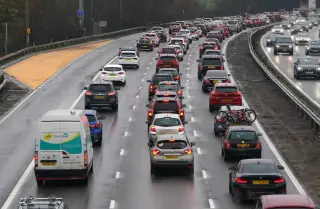
The hard shoulder remains one of the most critical yet misunderstood features of UK motorways. With the ongoing controversy surrounding smart motorways and the removal of traditional hard shoulders on many routes, understanding when and how you can legally use this emergency lane has never been more important for fleet operators and drivers alike.
This comprehensive guide covers everything you need to know about hard shoulder regulations, smart motorway safety, emergency procedures, and the penalties for misuse; essential knowledge for anyone managing vehicles on Britain's motorway network.
What is a hard shoulder?
The hard shoulder is the narrow lane running along the far-left edge of a motorway, separated from the main carriageway by a solid white line.
In the UK, hard shoulders are typically 3.3 metres wide and constructed from hardstanding material capable of bearing the weight of heavy vehicles, which is where the term 'hard' originates, distinguishing it from the soft grass verges found on many A-roads.
The boundary between the hard shoulder and lane one is marked by a rumble strip, a ridged white line that creates a distinctive sound and vibration if a vehicle strays onto it, helping prevent accidental entry. Small red reflective studs (cat's eyes) also mark this boundary, providing visual guidance at night.
What's the purpose of the hard shoulder?
The hard shoulder serves several vital functions:
Emergency refuge: Providing a safe stopping place for vehicles experiencing mechanical failures or breakdowns.
Medical emergencies: A space to stop when drivers or passengers require urgent medical attention.
Emergency vehicle access: Enabling ambulances, fire engines, and police vehicles to bypass traffic congestion.
Recovery operations: Allowing breakdown recovery services to safely attend to stranded vehicles.
When can you legally use the hard shoulder?
The Highway Code (Rules 270-271) sets out strict guidelines for the use of the hard shoulder.
You may only stop on the hard shoulder in the following circumstances:
A vehicle breakdown or mechanical defect — including running out of fuel, oil, or water.
In an accident or medical emergency — when you or a passenger requires urgent attention.
At the direction of authorities — when instructed by police, traffic officers, or highway officers.
When directed by road signs or electronic signals — when overhead gantry signs authorise use, typically showing a speed limit.
Roadworks — when yellow signs direct traffic to use the hard shoulder.
In allowing emergency vehicles to pass — briefly pulling left to create space for blue-light vehicles.
Important: The emergency must arise after you have entered the motorway. You cannot legally enter a motorway knowing you will need to stop on the hard shoulder.
What can't you do on the hard shoulder?
The hard shoulder is not for:
Making or receiving phone calls.
Taking a rest break or sleeping.
Using the toilet.
Checking maps or navigation.
Eating or drinking.
Picking up or dropping off passengers.
Undertaking slower traffic.
What are the penalties for misusing the hard shoulder?
Improper use of the hard shoulder can result in significant penalties:
Offence | Fine | Penalty points |
Illegal stopping on the hard shoulder | £100 | 3 points |
Unlawful stopping (general) | Up to £2,500 | None |
Careless driving | Variable | 3-9 points or ban |
Dangerous driving | Unlimited | Min 12-month ban |
Driving on a closed hard shoulder (Red X) | £100 | 3 points |
The specific charge depends on the circumstances. A brief stop for a non-emergency might attract the standard fixed penalty, while driving along the hard shoulder could be treated as dangerous driving, particularly if it endangers other road users.
Hard shoulders and smart motorways
The introduction of smart motorways has fundamentally changed how hard shoulders operate on many UK routes, and understanding the different types is essential for safe driving.
What are the different types of smart motorways?
1. Controlled motorways
These retain a permanent hard shoulder. Variable speed limits displayed on overhead gantries help manage traffic flow, but the hard shoulder remains available for emergencies at all times.
The M25 between junctions 10 and 15 was the first UK example, introduced in 1995.
2. Dynamic hard shoulder (DHS)
The hard shoulder opens temporarily during peak traffic periods. Electronic signs indicate when it's open (displaying a speed limit, typically 60mph) or closed (showing a Red X or remaining blank).
Found on sections of the M42, M1, M6, M4, and M5.
3. All Lane Running (ALR)
The most controversial type, where the hard shoulder is permanently removed and converted into a live traffic lane. There is no hard shoulder available at any time. Emergency Refuge Areas (ERAs) are provided approximately every 1-1.5 miles, marked with orange surfacing and equipped with SOS phones.
Found on sections of the M1, M4, M6, M25, M42, and M62.
Smart motorway safety concerns
Smart motorways, particularly All-Lane Running schemes, have generated significant controversy regarding safety:
Key statistics about smart motorway safety:
38% of breakdowns on ALR motorways occur in live lanes, compared to 20% on conventional motorways.
BBC Panorama reported 38 deaths on smart motorways between 2015 and 2020.
Near-misses on some M25 sections increased significantly after hard shoulder removal.
National Highways reports 100+ people are killed or injured on hard shoulders annually.
Government response: In April 2023, the government announced that no new smart motorway schemes would be built, citing costs and lack of public confidence. Existing ALR motorways remain operational, with ongoing investment in safety technology, including Stopped Vehicle Detection (SVD) radar systems designed to identify broken-down vehicles in live lanes.
Emergency procedures: what to do if you break down on the motorway...
If you break down on a conventional motorway with a hard shoulder:
Pull over safely: Move to the hard shoulder as soon as possible, pulling as far left as you can.
Activate hazard lights immediately: Turn on sidelights in poor visibility or at night.
Exit the vehicle safely: Leave through the left-hand (nearside) doors only, away from traffic.
Move behind the barrier: If there's a safety barrier, wait behind it. If not, move well away from the carriageway.
Use the SOS phone: Orange emergency phones are positioned every mile and connect directly to the National Highways or the police. They pinpoint your exact location automatically.
Do not attempt repairs: Never try to fix your vehicle on the hard shoulder unless absolutely essential for safety.
If you break down on an All-Lane Running smart motorway
If you cannot reach an Emergency Refuge Area:
Move left if possible: Get as close to the nearside verge as you can.
Activate hazard lights: Make your vehicle as visible as possible.
Exit if safe to do so: If you can safely leave the vehicle, move behind the barrier or as far from traffic as possible.
If you can't exit, stay in the vehicle with the seatbelt on if exiting would put you in greater danger.
Call 999: If you have no phone signal, use the emergency SOS feature.
National Highways monitors motorways via CCTV and Stopped Vehicle Detection systems. Once a stationary vehicle is detected, operators can close lanes using Red X signals and dispatch traffic officers or recovery services.
Rejoining the motorway safely
When you're ready to rejoin traffic from the hard shoulder or Emergency Refuge Area:
Ensure your vehicle is roadworthy (engine running, tyres inflated, all occupants wearing seatbelts).
Build up speed along the hard shoulder before attempting to merge.
Check mirrors thoroughly and indicate right.
Wait for a safe gap in lane one traffic.
Merge smoothly, matching the speed of the traffic ahead.
Motorway and hard shoulder guidance for fleet managers
For businesses operating vehicles on UK motorways, understanding hard shoulder regulations is essential for driver safety and compliance:
Driver training recommendations
Ensure all drivers understand the differences between the types of smart motorways.
Train drivers to recognise overhead gantry signals, particularly Red X lane closures.
Emphasise the importance of pre-journey vehicle checks to reduce breakdown risk.
Include emergency procedures in driver handbooks.
Vehicle preparation
Maintain comprehensive breakdown cover for all fleet vehicles.
Equip vehicles with high-visibility jackets, warning triangles, and torches.
Ensure fuel card accounts are maintained to prevent driverfrom s running out of fuel.
Consider telematics systems that can alert managers to vehicle faults before they cause breakdowns.
Understanding 'Red X' signals on UK motorways
A Red X displayed on overhead gantries means the lane is closed. This could indicate a breakdown, accident, debris, or roadworks ahead. Driving in a lane showing a Red X is illegal and dangerous.
The penalty for ignoring a Red X is a £100 fine and 3 penalty points. In serious cases, this can escalate to prosecution for dangerous driving.
National Highways uses cameras to enforce Red X compliance. When you see a Red X, you must move out of that lane as soon as it is safe to do so.
The future of hard shoulders in the UK
Following significant public concern and parliamentary scrutiny, the government's April 2023 decision to halt new smart motorway construction represents a turning point. Key developments include:
No new All Lane Running schemes will be built.
Existing smart motorways will remain operational, with enhanced safety measures in place.
Continued rollout of Stopped Vehicle Detection technology.
Emergency Refuge Areas are being added at closer intervals on existing ALR routes.
Five-year safety data collection to inform future policy decisions.
For fleet operators, this means continued vigilance is required when driving on existing smart motorway sections, while conventional motorways with permanent hard shoulders will likely remain the standard for new construction.
Key takeaways: what you need to know about the hard shoulder on UK motorways...
The hard shoulder is for genuine emergencies only, never for rest stops, phone calls, or convenience.
Penalties for misuse range from £100 fines to prosecution for dangerous driving.
On All-Lane Running smart motorways, there is no hard shoulder, so use Emergency Refuge Areas.
Always follow Red X signals and variable speed limits on smart motorways.
If you break down, make yourself visible, exit safely if possible, and call for help.
Fleet operators should ensure comprehensive driver training on motorway safety procedures.
Understanding hard shoulder rules helps keep you and other drivers safe. With proper preparation, awareness, and adherence to regulations, fleet drivers can navigate Britain's motorway network safely and confidently.
About Right Fuel Card
Right Fuel Card is a leading UK business fuel card provider dedicated to helping businesses of all sizes, from sole traders to large fleets, take control of their fuel costs and simplify fuel expense management. With access to over 98% of UK fuel stations, competitive pricing, and HMRC-approved digital invoicing, we make fuel management effortless whilst helping you save money. Our comprehensive service includes detailed online reporting, dedicated customer support, and optional RightProtect legal support for complete peace of mind on the road. Whether you're managing a single vehicle or an entire fleet, Right Fuel Card provides the tools and support you need to operate efficiently and compliantly.
Ready to start saving on fuel costs? Compare fuel cards online to find the perfect solution for your business. It takes just minutes to see how much you could save, and our expert team is ready to help you get started today.
This article was written on Wednesday, 28th January 2026 and published on Wednesday, 28th January 2026. All information contained within is correct at the time of writing. We try our best to continue to update our guides, but not all guides are regularly reviewed - for the latest news and insight visit: rightfuelcard.co.uk/news-insights


